
Last updated 25. May 2026 | Sprecherinnen
From May 18th to June 10th 2026, a month of remembrance takes place on the campus of Leuphana University Lüneburg (the site of the former Scharnhorst Barracks) under the theme: “A beginning of visible campus history. No end to a culture of remembrance.” Together we commemorate the victims of National Socialism and debate how to engage with the history of our campus.
The Scharnhorst Barracks, built in 1936, housed among others Infantry Regiment 47 and parts of Infantry Division 110 of the Wehrmacht, which were deployed from Lüneburg and the surrounding region in Southeast Europe, North Africa and Russia as part of so-called “Operation Barbarossa” – the code name for the war of annihilation against the Soviet Union – and were involved in various war crimes. The National Socialist past is not visible on today’s campus of Leuphana University Lüneburg.
We want to change that! During the month of remembrance, the #StolenMemory exhibition container of the Arolsen Archives is our guest on campus, and around it a whole month of events, encounters and remembrance takes shape.
This month we invite students and citizens of Lüneburg to engage with the crimes of National Socialism, to commemorate the victims and to revive an active culture of remembrance.
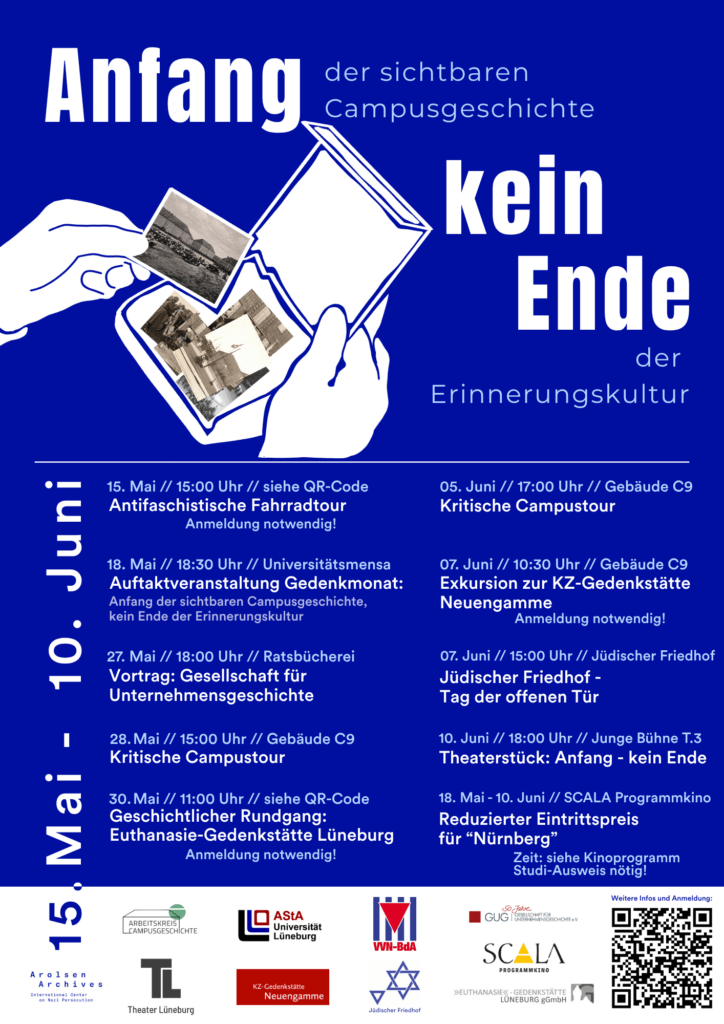
Program
18.05. – 10.06.2026 // University-Mensa // German and English
Exhibition Container #StolenMemory in cooperation with the Arolsen Archives
#StolenMemory is a campaign by the Arolsen Archives to return personal belongings – so-called effects – of former concentration camp prisoners to their families. As part of the funding programme “Culture in Rural Areas” of the Federal Government Commissioner for Culture and the Media, a mobile #StolenMemory travelling exhibition was developed, installed in a shipping container. It is accompanied by a website, an app and educational materials.
The Arolsen Archives are an international centre on National Socialist persecution, holding the world’s most comprehensive archive on the victims and survivors of National Socialism. The accompanying materials were awarded the Grimme Online Award in 2020 and can be viewed at https://stolenmemory.org/
The exhibition container will be located in front of the university canteen from May 18th to June 10th 2026, and is open Monday to Friday from 10:00 am to 6:00 pm. Visits on weekends are possible by appointment (contact via sprecherinnen@asta-lueneburg.de).
15.05.2026 // 3:00 pm // Reichsbahnwagon in Wandrahmpark // Registration required! // German only
Antifascist Cycling Tour
In the final days of the Second World War, the largest war crime on Lüneburg soil took place. The SS and Wehrmacht murdered a total of 385 concentration camp prisoners from a transport from Wilhelmshaven to Neuengamme, carried out by the Deutsche Reichsbahn, which came to a halt at Lüneburg freight station.
The tour leads to the individual sites of the crime, beginning at the Reichsbahn wagon in Wandrahmpark in Lüneburg and ending at the memorial cemetery in Wilschenbruch.
Duration: approx. 1.5 hours – Meeting point: Reichsbahnwagon in Wandrahmpark – Price: €5
Registration: 04131-40360 or info@geschichtswerkstatt-luenburg.de
18.05.2026 // 6:30 pm // University-Mensa // German only
Opening Event: A beginning of visible campus history. No end to a culture of remembrance.
We celebrate the opening of our month of remembrance on Monday, May 18 at 6:30 pm right around the container: outside in front of the canteen, at eye level, with brief contributions from the city, the university and the Arolsen Archives. With musical accompaniment by the Cantorum of Leuphana University, followed by a Critical Campus Tour. We welcome everyone who joins us!
The event will likely take place outdoors.
27.05.2026 // 6:00 pm // Ratsbücherei // German only
Talk: Gesellschaft für Unternehmensgeschichte
The Gesellschaft für Unternehmensgeschichte (GUG) is an internationally recognised academic institution dedicated to promoting research in business history. It combines academic expertise with practical consulting. One of the GUG’s specialisations is the study of the history of companies during the Third Reich, with the aim of providing a scientifically grounded assessment of corporate responsibility in its historical context.
Dr. Ronja Kieffer, Head of Studies at the GUG, offers insights into the organisation’s work and uses concrete examples to show how business history is researched, processed and communicated. The talk is aimed at anyone interested in economic history, historical business research or the interface between academia and practice.
More information at: https://unternehmensgeschichte.de
28.05.2026 // 3:00 pm // Campus Building C9 // German and English
Critical Campus Tour
What lies behind the buildings where we spend our everyday lives? The Critical Campus Tour of the Öko?-logisch! department, the AK Campusgeschichte and the AStA invites you to rediscover the campus of Leuphana University Lüneburg. As an alternative to the official campus tour, we take a critical look at the history of the campus – beyond marketing and glossy brochures. Together we examine what the university and campus show to the outside world, and what remains (still) invisible.
We meet in front of Building C9.
30.05.2026 // 11:00 am // »Euthanasie«-Gedenkstätte Lüneburg gGmbH // Registration required! // German only
Historical Tour: Euthanasia Memorial Lüneburg
The »Euthanasia« Memorial Lüneburg is located on the site of the former Lüneburg Psychiatric Institution, from which forced sterilisations were carried out from 1934 and various »euthanasia« measures from 1941. The memorial informs visitors about the dark history of the Lüneburg institution, particularly regarding racial hygiene and eugenics, the history of nursing and medicine, the history of people with disabilities, forced sterilisation, the »euthanasia« of children and young people, »Aktion T4«, »decentralised euthanasia« extending into the early post-war period, as well as responsibility, perpetration and the processing of these crimes after 1945. Alongside these historical themes, the memorial also addresses contemporary issues such as children’s human rights, the human rights of people with disabilities, life with a mental illness or disability, and inclusion.
Join us on a tour of the grounds of the Lüneburg Psychiatric Clinic and immerse yourself in the history of the former institution. The meeting point is in front of the Documentation Centre in the former bathhouse (Building 34), and we will be on the move together for approximately two hours. The exhibition in the Documentation Centre can also be visited after the tour.
Register here.
05.06.2026 // 5:00 pm // Campus Building C9 // German and English
Critical Campus Tour
What lies behind the buildings where we spend our everyday lives? The Critical Campus Tour of the Öko?-logisch! department, the AK Campusgeschichte and the AStA invites you to rediscover the campus of Leuphana University Lüneburg. As an alternative to the official campus tour, we take a critical look at the history of the campus – beyond marketing and glossy brochures. Together we examine what the university and campus show to the outside world, and what remains (still) invisible.
We meet in front of Building C9.
07.06.2026 // 10:30 am // Campusbuilding C9 // Registration required! // German and English
Excursion to the KZ Neuengamme Memorial
In late 1938, the SS established a satellite camp of KZ Sachsenhausen in a disused brickworks in Hamburg-Neuengamme. From 1940, it became an independent concentration camp and until 1945 served as the central concentration camp of northwest Germany. Tens of thousands of people from all occupied countries in Europe were deported here – for resisting the occupation, refusing forced labour, or due to racist persecution. In Neuengamme and its more than 85 satellite camps, prisoners were forced to perform heavy labour for the war economy. At least 42,900 people lost their lives – in the main camp, in the satellite camps, or during the camp evacuations at the end of the war.
The excursion to the KZ Neuengamme Memorial offers the opportunity to experience this place of remembrance in person. Travel is by shared bus. Places are limited – early registration is recommended.
Register here.
07.06.2026 // 3:00 pm // Jewish Cemetery // German only
Jewish Cemetery – Open Day
The Jewish Cemetery in Lüneburg has a turbulent history. Founded in 1823 – after almost 150 years during which the Jewish community had to bury its dead in other towns – it grew over the decades into an important site for Lüneburg’s Jewish community. During the November Pogroms of 1938 it was desecrated, and in the winter of 1943/44 the city had the grounds levelled and almost all gravestones removed. For decades it remained a forgotten place. Since 2022 the cemetery has been gradually restored – in May 2026 the restoration was completed. The few surviving gravestones have been re-erected, and six steles now bear the names of all those buried here. The restored mourning hall serves today as a place of learning, encounter and remembrance.
On the Open Day, the cemetery opens its gates and invites visitors to discover this place of remembrance. Guided tours of the grounds take place every hour at 3, 4 and 5 pm.
More information at: https://jüdisches-leben-in-lüneburg.de
10.06.2026 // 6:00 pm // Junge Bühne T.3 // German only
Theatre Performance: Anfang – kein Ende
Lüneburg, 1945: In a gymnasium on Lindenstraße – long since demolished, once in the immediate vicinity of today’s theatre – the first Bergen-Belsen Trial took place. 45 alleged perpetrators from KZ Bergen-Belsen stood trial; eleven were sentenced to death. Seventy years later, another and final National Socialist trial took place in Lüneburg: Oskar Gröning, “The Accountant of Auschwitz”, was charged with aiding and abetting murder in 300,000 cases.
Theater Lüneburg takes the 80th anniversary of liberation from National Socialism as an opportunity for a local research project: How were these trials perceived by Lüneburg’s society? What happened in the decades in between? Eyewitnesses, experts and citizens are given a voice.
After the performance (running time: 1 hour 40 minutes), we invite you to a post-show discussion: together with the two dramaturges we explore the research behind the production and open up the conversation. This event also marks the conclusion of our month of remembrance, and the AK Campusgeschichte will close the evening with a final word of thanks.
A limited number of free tickets are available for students – get in touch with us now to secure yours. Should all free tickets be taken, the Semesterticket Kultur remains valid as usual.
Find the registration for students here.
Further information and tickets: https://www.theater-lueneburg.de/anfang-kein-ende
18.05. – 10.06.2026 // SCALA Programmkino // German and English
Reduced Admission for “Nürnberg”
This month of remembrance shines a light on the crimes of National Socialism and their judicial reckoning – and that is precisely what this film is about. SCALA Programmkino is showing Nuremberg at a specially reduced rate for students. (Student ID required!)
Nuremberg, 1945. In the ruins of a destroyed city, American military psychiatrist Dr. Douglas M. Kelley receives an unusual assignment: he is to assess the imprisoned senior figures of the Nazi regime in preparation for the Nuremberg Trials. Among them is former Reichsmarschall Hermann Göring, whose intelligence and manipulative power both challenge and fascinate Kelley. A gripping thriller drama about the Nuremberg Trials and the birth of modern international law.
Further information and tickets: https://www.scala-kino.net/filme/nuernberg
